Coruña, The Next Stage
Monday, January 19, 2009


Friday, January 16, 2009
Bmx Bike For 50 Dollars
landing in the Hudson


[...]'s expertise lies in a splashdown fly slowly enough to not destroy the plane, and fast enough to avoid stalling and collapse on the water [...]
Many times I reported on this blog that all emergencies are planned, tested and contained in procedures to which every pilot is consistent. However, there are certain situations as depressurized or landing can not be tested until the end. Not like an engine failure in the procedure you do engine off and get to the airport. In other words, any pilot knows what a depressurization until the sufferer.
The same applies to the landing. In the pilot school always advised against the landing but had not any possibility to make an emergency landing on the ground. From the tub, the water may look harmless but at 300 km / h is as hard as concrete, with the particularity that it can not support you. The landing procedure is an extension of the procedure for landing with engine failure, ie the short motor, fly the airplane within the parameters of the plan, declare emergency, cut off all electrical items and take protective measures. Lands on the sea is always parallel to the waves, not against, and with the headwind, as if we were to take in a field. Crosswind If you choose a 45 degree angle between the wind and waves, seeking always to make the maneuver as close to the coast. So here is any procedure.
However, when "wet" where everything changes with respect to a decision on the ground. It is obvious that water offers much greater resistance to advancing the land. In an aircraft there are two parties that generate much resistance if a landing, are the landing gear and engines for aircraft which are under the wings. That is why you should ditch the train withdrawn, because the slightest impact against the water, pull it out, taking with it parts of the wings or destabilizing the plane. With the other it is the same, but they are an insurmountable obstacle when ditch. That's why making the water should be as smooth as possible, flying slowly enough to not destroy the plane, and fast enough to avoid stalling and collapse. And this last is a matter of skill and luck, a lot of luck, 90% of the landing is counted dead, not only from impact with the water, but because those who are lucky enough to survive this, they usually die of hypothermia.
Yesterday, a U.S. Airways A320 emergency had to ditch in the Hudson River with 155 people aboard, after a total loss of power after takeoff. The plane only reached 3,000 feet before beginning his glide to the river, splashed down speed 150 knots (280 Km / h). No passenger was killed thanks to great work of the crew, in a very limited time made a perfect landing and the evacuation of all occupants.
The same applies to the landing. In the pilot school always advised against the landing but had not any possibility to make an emergency landing on the ground. From the tub, the water may look harmless but at 300 km / h is as hard as concrete, with the particularity that it can not support you. The landing procedure is an extension of the procedure for landing with engine failure, ie the short motor, fly the airplane within the parameters of the plan, declare emergency, cut off all electrical items and take protective measures. Lands on the sea is always parallel to the waves, not against, and with the headwind, as if we were to take in a field. Crosswind If you choose a 45 degree angle between the wind and waves, seeking always to make the maneuver as close to the coast. So here is any procedure.
However, when "wet" where everything changes with respect to a decision on the ground. It is obvious that water offers much greater resistance to advancing the land. In an aircraft there are two parties that generate much resistance if a landing, are the landing gear and engines for aircraft which are under the wings. That is why you should ditch the train withdrawn, because the slightest impact against the water, pull it out, taking with it parts of the wings or destabilizing the plane. With the other it is the same, but they are an insurmountable obstacle when ditch. That's why making the water should be as smooth as possible, flying slowly enough to not destroy the plane, and fast enough to avoid stalling and collapse. And this last is a matter of skill and luck, a lot of luck, 90% of the landing is counted dead, not only from impact with the water, but because those who are lucky enough to survive this, they usually die of hypothermia.
Yesterday, a U.S. Airways A320 emergency had to ditch in the Hudson River with 155 people aboard, after a total loss of power after takeoff. The plane only reached 3,000 feet before beginning his glide to the river, splashed down speed 150 knots (280 Km / h). No passenger was killed thanks to great work of the crew, in a very limited time made a perfect landing and the evacuation of all occupants.
Saturday, December 13, 2008

Monday, September 29, 2008
Headphone Cable Red Yellow And White
the stories of a flight to Compostela
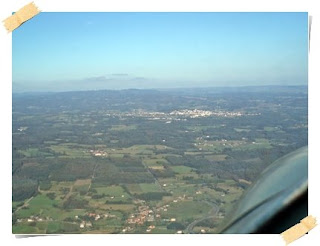 Lavacolla (Santiago de Compostela) is the main airport in Galicia. It is located 30 miles south of Corunna, on high ground surrounded by a huge forest. It's an airport I go since I was very small, in Lavacolla took my first plane, so a special feeling cuandoaterriza there. However it is an airport that flies frequently because of its proximity to Corunna does not compensate for the 20-minute flight between the two airports. In addition, commercial traffic at both airports makes the ground waiting times are significant, with a corresponding fuel consumption. To get an idea, the flight time between return is just 40 minutes, but the total time from engine start to stop is nearly two hours, and 30 liters of fuel.
However, I decided to fly to Santiago for reasons of access. Since now the days are shorter, I decided to fly the shortest route for the East, from the point Echo1 to Echo2. The wind on the runway was Coruña Northwest at 10 knots, which is a considerable headwind that makes you climb like an elevator. And it seems that things would get worse, because my return is expected gusts of 20 knots. Curtis spent about 4,500 feet and within minutes I started to go down Register to 2,500 feet. Since there are about 9 minutes Lavacolla in a westerly direction. I dismiss the Santiago Approach Control and Tower step Lavacolla, which authorizes me to proceed to the traffic circuit for runway 35 right, but not before making a couple of waiting to make way for a plane of Air Berlin, which came on approach.
 Lavacolla The track has more than 3,000 meters and tracks such airports with some movement of commercial traffic requiring the pilot flying a light aircraft landing adjust enough to leave the track as soon as possible avoid causing delays in planes waiting for takeoff. For example, entering on runway 35, the first output is more than a mile from the header. That for a light aircraft is a world if you take in the header have to shoot at a very slow speed for at least a kilometer, which will be occupying the track and force commercial traffic to be delayed in takeoff or landing . The best thing to do in these cases is to go higher and landing well past the runway threshold to adjust to the first exit.
After leaving the runway 35 I did something unexpected. Lavacolla tower allowed me to park in the parking standard. The last time I had been there, parked in general aviation now called the P-4, guided by the signalman. However, this time not come any signalman so I went to the park where he had parked the last times. I was surprised to see painted on the ground arcs parking areas for large aircraft. I stopped the engine and soon see the signalman in his "yellow." After a conversation with him, which I thought we both had the same doubts about where to leave the plane, got to let me park there for an hour. Later I discovered that this area is where today parked Air Nostrum CRJ while the general aviation apron was displaced and was known as P-3. If you need to review the updates of the charts!
 Just off the plane and walked down the platform between the baggage carousels to the terminal. This is where the driver has to be careful because as being "half air" makes him somewhat confused when moving by land. When I was at school always told me to look for the "C", a sign indicates that this is the crew access to the terminal. I say be careful because as you get into any site without permission you may end up throwing out the dogs. The first thing I did was go to coordination to pay € 4 for landing and parking fees. If we consider the money involved in aviation could say that 4 € are a pittance, but make no mistake; go away without paying and you will turn around in the air. Processed
and paperwork, fees, weather and flight plan back to Coruña, played relax. So within an hour had to take the flight back to Corunna. In the end I was waiting for my girlfriend. We take for lunch one of those expensive snack foods sold in cafeterias airports. For lovers of statistics will tell you that it is cheaper landing and parking in Lavacolla to eat a sandwich with a bottle of water, funny, right?. Fifteen minutes before the scheduled flight headed for the platform to initiate the inspection of the aircraft. In the tanks had fuel for just over two hours of flight so did not need refueling. It was enough to return to Corunna and diverted to an alternate if unable to land at the destino.Me went to the other end of the terminal to a control that says "General aviation crews," where I expected the security personnel. Here begins the real plight of the drivers who have no AENA card. Not only do not know what to do with you but you are questioning. Yet no one ever asked me my pilot's license.
certainly believe that within the whole complexity of the aviation system, safety checks of pilots is one of the unresolved, perhaps a product of an administration that ignores general aviation. It should provide private pilots some identification in order to move through airports and thus facilitate the work of security personnel, at least, paving the way with their kindness. 

However, I decided to fly to Santiago for reasons of access. Since now the days are shorter, I decided to fly the shortest route for the East, from the point Echo1 to Echo2. The wind on the runway was Coruña Northwest at 10 knots, which is a considerable headwind that makes you climb like an elevator. And it seems that things would get worse, because my return is expected gusts of 20 knots. Curtis spent about 4,500 feet and within minutes I started to go down Register to 2,500 feet. Since there are about 9 minutes Lavacolla in a westerly direction. I dismiss the Santiago Approach Control and Tower step Lavacolla, which authorizes me to proceed to the traffic circuit for runway 35 right, but not before making a couple of waiting to make way for a plane of Air Berlin, which came on approach.
 Lavacolla
 After leaving the runway 35 I did something unexpected. Lavacolla tower allowed me to park in the parking standard. The last time I had been there, parked in general aviation now called the P-4, guided by the signalman. However, this time not come any signalman so I went to the park where he had parked the last times. I was surprised to see painted on the ground arcs parking areas for large aircraft. I stopped the engine and soon see the signalman in his "yellow." After a conversation with him, which I thought we both had the same doubts about where to leave the plane, got to let me park there for an hour. Later I discovered that this area is where today parked Air Nostrum CRJ while the general aviation apron was displaced and was known as P-3. If you need to review the updates of the charts!

and paperwork, fees, weather and flight plan back to Coruña, played relax. So within an hour had to take the flight back to Corunna. In the end I was waiting for my girlfriend. We take for lunch one of those expensive snack foods sold in cafeterias airports. For lovers of statistics will tell you that it is cheaper landing and parking in Lavacolla to eat a sandwich with a bottle of water, funny, right?. Fifteen minutes before the scheduled flight headed for the platform to initiate the inspection of the aircraft. In the tanks had fuel for just over two hours of flight so did not need refueling. It was enough to return to Corunna and diverted to an alternate if unable to land at the destino.Me went to the other end of the terminal to a control that says "General aviation crews," where I expected the security personnel. Here begins the real plight of the drivers who have no AENA card. Not only do not know what to do with you but you are questioning. Yet no one ever asked me my pilot's license.
certainly believe that within the whole complexity of the aviation system, safety checks of pilots is one of the unresolved, perhaps a product of an administration that ignores general aviation. It should provide private pilots some identification in order to move through airports and thus facilitate the work of security personnel, at least, paving the way with their kindness.
Subscribe to:
Posts (Atom)